Do you still check on your Facebook? I do once in a while, usually to check on the Buy Nothing groups I belong to.
I used to post on Facebook often, mostly to share stories and things that made me laugh, start conversations, and (deep breath) occasionally offer political commentary. Yes, dear ones, I am one of those, and this is something I accept about myself. It’s been on my to-do list since I created this website to copy some of the non-political crowd favorites over to this blog.
Today I got a Facebook Memory notification about a post from seven years ago, and I remember the subject of the story fondly, so here we finally go.
The following is from June 24, 2014:
Last week while on vacation in Sea Isle City I ran out of sunscreen, so I went down the street to the little beach junk store to buy a bottle for infinity dollars.
While the clerk was ringing me up I noticed her iPhone on the counter; the screen had a huge crack and was shattered in the bottom right corner. “Oh no!” I said, “What happened!?”
An older lady was walking by behind me as the clerk replied, “Oh, you know, I just had a little mishap.” She watched as the lady disappeared down an aisle, then leaned in and said in a low voice:
“You wanna know the real reason?”
“Obviously,” I said eagerly.
She looked around, then motioned for me to lean in:
“This bitch, she’d been needling me and NEEDLING me, for months now. I warned her to stay away from me, but bitch didn’t listen.” She grinned. “So I saw her out the other night and my friends saw me goin’ up to her and yelled at me, ‘NO, DON’T! GIRL IT AIN’T WORTH IT!'”
At this point I was pumping my fists encouragingly. She continued.
“But I didn’t listen. I went up to that bitch and we were having some words and finally I was just all, ‘BITCH I’M TIRED OF YOUR SHIT!’ And I threw my phone at her STUPID head!”
“YES!” I hollered, “THAT IS AWESOME! WHAT DID SHE DO!?”
“Bitch screamed, ‘YOUR PHONE’S BROKE! WAS IT WORTH IT!?’ And I hollered right back, ‘HELL YEAH IT WAS WORTH IT YOU DUMBASS!'”
She nodded stoically. “And it was. It was totally worth it.”
This is the Sea Isle condo some friends and I used to rent; first floor, left side. The house, built in 1910, was at some point divided into 5 condos: 2 on both the first and second floors, and one — where the sisters who owned it lived year-round — encompassing the entire 3rd floor. The whole thing slanted to the left, you could put a ball down on one end of the condo and it would roll to the other end. Everything was warped; the outside doors could barely close. We loved it. It started to fall down on its own, so they demolished it for good a few years ago and replaced it with a monstrosity devoid of character. It had a path straight from the deck to the beach… sigh.
My dad introduced me to them when I was a kid. Whenever I left the house for suburban neighborhood playtime (we loved making up games in the foundations of houses under construction, until that numnuts Kevin fell and broke his leg), he never failed to recite his parting advisement: Be safe, look both ways.
When I got older, he enlightened me to the most important mantra I’ve adopted to date:
Play with pain.
Allow me to break it down into its 3 primary applications.
You are more powerful than physical pain. This is the most literal interpretation of the mantra, and its foundation. At 6’4″ my dad, Carl, was a formidable offensive end & tackle for his high school’s football team* who often stayed in the game after getting the wind knocked out of him. He created the mantra as a reminder that one’s willpower can overcome their brain’s pain signals.
I called on the mantra for help during a field hockey game in 10th grade, when a pigtailed incendiary from the opposing team hacked away at my stick in a chaotic attempt to steal the ball, pummeling my right thumb in the process and earning herself a foul. As I prepared to take my free hit, I noticed my thumb hadn’t stopped throbbing yet, so I quickly examined it and looked into the crowd for my dad — he met my eyes, nodded, and gave a thumbs up. F*ck it, I thought, of course I’m fine!Play with freakin’ pain.
Months later my doctor would inform me my thumb had broken, but was already nearly healed without intervention. It’s slightly crooked, sure, but still works at 100% capacity as far as I can tell.
Can you tell which one got the stick?
You can deal with emotional pain. This type of pain bites harder than the physical kind, at least to me, and I think Carl would agree. In these instances, the encouragement to play with pain reminds one that suffering is an intrinsic part of life; there’s no way to avoid it — you’d have to become a recluse.
My dad and I have similar personalities (I’m an ENFJ and Enneagram 2, if that means anything to you, readers), and until I was able to forge strong friendships, he served as my default listener and advice-giver. He’s still in the top three.
He coached Growing Lauren in the art of dealing with intense emotions and venting them in healthy ways. But everybody boils over sometimes, and one of his favorite stories to tell about me is an incident that occurred in the summer of 2004, after my freshman year at college.
I had a summer job in the patient record department at the hospital where Carl worked, and one mid-morning my friend George dropped a grenade in my lap via text message: my recently ex-boyfriend was seeing a new girl. My face suddenly burned, chest tightened, and stomach seized. I knew this combination — I was about to crumble. I excused myself from the small windowless office I shared with five people and three behemoth, overheated industrial scanners** and made a beeline for Carl’s office.
A man stood in the doorway having a casual chat with him when I blew in. I elbowed that dude out of the way, wobbly croaked “I HAVE A MEETING,” and slammed the door shut before proceeding with the crumble. My dad of course comforted me, and a bit later I was ready to re-join the world.
He waited until the next day to tell me (with slight glee) that the dude I treated to my elbow was the CEO of the hospital.
You gotta get real weird with it. I haven’t run this application past Carl yet; I’m guessing he would think it’s strange but still listen graciously.
Have you seen the show It’s Always Sunny in Philadelphia? Danny DeVito plays Frank Reynolds, a formerly wealthy businessman who ditched the corporate world to embrace his feral nature. Two of his shenanigans that make me wheeze-laugh are when he trips on acid and gets stuck in a bucket, and the time he emerges naked from a couch during a Christmas party.
Frank attends a relative’s funeral in one episode, where he wistfully opines to his friends and family:
“Well — I don’t know how many years on this Earth I got left…I’m gonna get reeeeeal WEIRD with it.
That’s the type of absurdist energy behind this interpretation of the mantra, which I’m struggling to describe without hackneyed references to the universe and life.
So I’ll defer to 50 Cent!
“Many Men (Wish Death)” came out in 2003, which means my fellow glaringly white suburbanite peers and I were butchering the song the year we graduated high school. 50 paraphrases an old adage, saying:
Sunny days wouldn’t be special if it wasn’t for rain Joy wouldn’t feel so good if it wasn’t for pain
I mean, how can you improve on that succinct conclusion? The man was shot NINE TIMES in the year 2000, so I feel like he’s earned our listening ears when he talks about life and death.
To get to the damn point already: If we can remind ourselves during the unpleasant parts that the difficulty will eventually give way, as it always has before, and always will… why not try to play with the pain a bit, get a little weird with it? I was depressed for a good chunk of the pandemic and am not embarrassed to admit that it led to the creation of some very emo art. I also leaned into it by breaking out my most depressing sheet music for the piano, and my Spotify playlist aptly titled, “For when you’re feeling 😔 .”
Fiona Apple’s entire discography may even be an example of this application of the mantra.
Me with my dad, two players of pain
I’ve mentioned before that I help take care of my upstairs neighbor, a kindergartener, who I refer to here as Sugar.† When the school year started virtually, she “attended” in the little classroom I set up in my apartment. Now that it’s in-person again, I drop her and three other neighborhood kids at their school in the morning.
One of the best parts of this relationship (speaking for myself, of course) is the chance to pass along my wisdom and life lessons to a young mind. I’ve taught her what to do if a man ever tries to abduct her (jab at the eyes and kick/punch the groin), how to deal with anxiety (personify it as a monster and talk back to it; she aptly named hers Trashy), the secrets to a bangin’ grilled cheese (before doing anything else in the pan, lightly toast the sides of the bread that’ll go on the inside of the sandwich)…
…and, obviously, how to play with pain. While she confidently grasps the first two applications of the mantra, we’ll need to the revisit the third in a couple years — too existential for kindergarten, I’ve learned.
You can imagine my delight when one day in the car, before we picked up the other kids, and months after I introduced the concept, she piped up from the back seat:
“Oh yeah, neighbor? Emma fell down on the playground yesterday. She was crying real hard. Her knee was bleeding. I told her how to play with pain.”
“WHAT!? YES! HOLY CRAP! Good job, sweetheart! What did Emma say?”
She thought for a second.
“Nothing. I’m not even sure she heard me. She cries loud.”
Footnotes:
*One of the stories I regularly harangue my dad to tell is the time during one of those high school football games that his quarterback took a humongous blow to the head. At first it looked like he was going to shake it off, but when he joined the next huddle, he looked into the wide receiver’s eyes and muttered apprehensively: “I don’t know if I can do this, mom.”
**That room smelled like sweat and melting plastic.
†She mostly calls me “neighbor,” because she got used to it before she was able to remember my name. If she ever outgrows it I will be upset.
I am bearing witness to online kindergarten, and of course have many thoughts to share about it. I’ll start here: it’s strange, moving, and hilarious.
It’s strange because kindergarten is not conducive to online learning. These kids are at the age where their natural inclination is to learn by exploring, touching, moving around, etc. They ought to be getting tempera paint on the classroom carpet and screeching at each other about fake cereal boxes in the play kitchen, not worrying about whether they remembered to un-mute themselves after getting called on by their teacher.
It’s moving because everyone is making the best of it: teachers, parents, and kids.
And it’s hilarious because… have you ever met a kindergartener? Harnessing the energy of 15 of them into one Zoom session will obviously produce amazing results.
I get to be part of this world because I’m supervising my upstairs neighbor, Sugar (that’s not her real name, I’m changing it here for her privacy), as she “attends” school in the mornings, while both her parents are at work.
Here are some things her classmates have un-muted themselves to announce to the class when the teacher asked if they had questions about the lesson:
“My dad is making me oatmeal.”
“Can I go to the bathroom?” Yes, you may. “OK. Sometimes when I go to the bathroom it doesn’t take long, but sometimes it does.”
“I don’t know where to put my booger.”
“My brother is supposed to be doing school on the computer too, but he… [searches for the right words] has issues.”
As for Sugar, she and I had this fantastic exchange last Thursday, during a break:
Sugar: [staring at me while we’re coloring]
Me: [notices her staring] Can I help you?
Sugar: …
Me: [goes back to coloring]
Sugar: Why… do you have holes in your face?
Me: You mean my nostrils? You have those too.
Sugar: No, the ones here [points to her cheek].
Me: Oh! You mean my dimples? [points to a dimple]
Sugar: Yes!
Me: That’s just the way my face is. Some people have them, some people don’t.
I lost two out of my top three clients (in terms of monthly revenue) because of the pandemic-related economic downturn, and reluctantly decided to end my contract with another because of severe problems in its operation — but a silver lining is that I’ve had more time for freelance reporting.
My degree is in journalism, but when I graduated the country was in the thick of the early-2000s newspaper decline. The two newspapers in Lancaster — I’d interned at one after my sophomore year — had just laid off dozens of employees, and two years later would go on to merge and lay off even more reporters. It was the same climate across the region, so in addition to applying for journalism positions, I applied to a bunch of related jobs — and that’s how my decade in lobbying began.
My favorite journalism professor was Judy Maltz (pictured left). She’s one of the few professors I remember in detail, because she taught me so many lessons valuable to my overall writing career — her dedication to preparing future journalists for truth-finding and telling was clear.
Maybe some of the best bits of proof of her excellence as an educator are the all-caps negative reviews on sites like RateMyProfessor.com, from students complaining that she was too hard 😏
She critiques your writing without regard to hurting your feelings, which is what you want out of writing criticism. She has that talent of being direct, able to tell you what you need to hear without fluffing it up — while still making you feel respected, and optimistic about your potential.
More important than hammering us on technique and style (and she did plenty of that, AP style now has dedicated wrinkles in my brain), she stressed the tenets and ethical responsibilities of journalism. If you had to boil it all down to one sentence, it’d be this: it’s your duty to dispassionately relay the facts of what occurred or was said.
I think it’s important for people (especially Americans) to realize that most journalists regard this a sacred responsibility.* Last year I saw someone accuse me of bias in a story I wrote; their beef was with something contained in a quote. If I could’ve, I would’ve explained that using quotes is a tactic journalists rely on in order to avoid expressing bias in a story. When you allow someone’s own words to do the speaking on their behalf when covering them for a story, you avoid the need to explain and paraphrase their thoughts yourself, which is a way for bias to sneak in via the words you choose.
It also makes it more clear that you are conveying what someone else said — not stating it as fact yourself, the reporter.
I’ve been thinking about this since a few weeks ago, when a communications staffer for a caucus in the state House accused a reporter of being an unfit journalist, because she expressed an opinion from her personal Twitter account — not about a story she’d covered, but about something political in general.
But that’s setting people up for no other choice but to distrust any and all media.
It’s impossible for a journalist to avoid holding an opinion on everything they cover. Simply by existing as a human, one has a reaction to input — in other words, when you learn or take in a piece of information, you’re going to feel a certain way about it.
Journalists are trained to report the facts without letting that reaction inform how they convey what transpired.
And when they do mess up — because no being is perfect in fulfilling the duties of their job — a good journalist will admit it, apologize, and do everything possible to set the record straight and notify the public about the error.
* I say “especially Americans” because we’re one of the countries that has fostered media sensationalism the most, and we have tons of “publications” that are thinly veiled publicity efforts from lobbying firms. I say “most” journalists for the same reason — but I think reporters for local newspapers are among those most likely to adhere to impartiality, because they’re more likely to have to acknowledge face-to-face the repercussions of bias and other errors, from people in the community where they live.
Given all the crises we’re faced with in 2020 — America’s continued reinforcement of white supremacy, a president checking off more and more fascism boxes, Papa John’s presence on Tik Tok — sometimes I feel like an asshole when I get caught up on a personal worry or indulge in silliness. For example, I’ll share a Tok like this, but the tweets from other people above and below it will have to do with someone in my age bracket dying from COVID-19,* and a Black girl being jailed for not doing her homework.
How can we sing about ourselves? How can we sing about love? How can we not sing about love? How can we not sing about ourselves?
When the king is made of paper And the king is made of piss The king is coming down the fucking wall
I am a stranger to religion’s fear I have no claim to the tears of the queer But I know it keeps the blind man’s white cane near The blind man keeps the white cane near
The songwriter wrote it shortly after Trump’s election, so you can deduce who the “King” is 😉
Immediately after typing that sentence I remembered that Radiohead referred to Bush II in a similar way, with “Hail to the Thief” in 2003. Lyrics from “2 + 2 = 5“:
All hail to the thief All hail to the thief (But I’m not, but I’m not!) (But I’m not, but I’m not!) Don’t question my authority or put me in a box (‘Cause I’m not, cause I’m not!) Oh, go and tell the king That the sky is falling in (But it’s not, but it’s not, but it’s not!) Maybe not, maybe not
Footnote:
* I think it’s barbarian that hospitals aren’t figuring out a way for a patient’s loved ones to say goodbye in person.
I run for my mental health even more than for my physical health. (Thanks for passing along the apple body shape though, making the latter necessary, Nana 😑 )
I love smelling the air, taking in the surroundings (pretty flowers, weird neighbors, etc.), and sweating. Man I love sweating; it feels like ickiness— every type of it, from environmental to mental — is leaving your body.
It’s how I get clarification on thought nuggets that’ve been playing on a loop in my head, and practice conversations I’m anxious to have. I like visualizing that my feet are stomping out my problems when they hit the concrete. Sometimes I imagine a specific person’s face meeting the bottom of my shoe. 😬
But I should clarify that for the past few years I’ve been jogging. I used to run, and maybe I will again. I’m currently letting too much time lapse between runs — err, jogs — though, so I’m not conditioned enough to keep a running pace for miles at a time.
The culprit is leg pain, mostly in my right knee. My hips are uneven because of idiopathic scoliosis, so it’s as if my legs are different lengths, with the right leg the “longer” one. This creates a cascade of musculoskeletal issues that are getting harder to ignore or fight through as I age.
It’s reached a tipping point, so I’m researching local physical therapy practices to see where my body’s at and correct the problems as much as possible. To help the therapist get the best picture of what’s going on in my body, I grabbed my spinal x-rays from my parents’ house a few weeks ago.
My spine!
A normal spine, via a Google Image search
I’ve been working with a therapist on building my self-esteem, and realize I need to give some resiliency points to 12-year-old Lauren — I went through some shit with this.
One of my clearest middle school memories is scoliosis screening day, when we reported in small clusters alphabetically to the nurse’s office. She took extra time on my back (and Mary’s*) and took longer to make notes for us than she had the other kids.
Everybody knows what that freakin’ means.
I remember that Damaso Maldonado — we were in homeroom together from 7th through 12th grades** — clearly saw the worry in my eyes, and gave me a stoic, comforting nod.
A letter arrived at home a few days later to confirm my suspicions; it notified my parents that they should have my pediatrician check it out. (Related: who else went to their pediatrician until they were 16? Mine even pierced my ears. I digress.) A couple weeks after that I was diagnosed, and we headed to duPont Children’s Hospital in Wilmington, DE, an hour and a half away, because my dad’s colleagues (he worked in health care) told him it was the best for adolescent scoliosis.
I have a 32 degree thoracic scoliotic curve convex to the right, and a 32 degree lumbar scoliotic curve convex to the left. This means I have Type 2 moderate idiopathic scoliosis. Because my scoliotic curves are convex, my ribs are spread a little farther apart than normal.
That’s where Dr. Mangeshkumar explained that I was at least fortunate to have Type 2 — my lumbar and thoracic curves form an “S” shape to somewhat compensate for each other, and it’s good that the curvature degrees are equal. He said I would be able to avoid surgery, and prescribed me a Wilmington brace to be worn all the time at home.
Surprisingly few images exist to pick from when you search for “Wilmington brace.” I’m gonna try my best to remember to take a photo of mine next time I’m at my parents’ house, where it lives in their basement. (I also hope to find my nudes down there someday. †)
Getting fitted for this thing is like performing a circus act. You’re balanced on a contraption called a Risser frame, and wrapped with plaster in order to create a mold for the brace.
By this time I had turned 13, and guess what. The young doctor who wrapped my body was hot af and I blushed the entire time.
This is what the process looks like. I KNOW, RIGHT?
I cried one time over the whole thing: the first night I had to wear it. You have to pull its straps really tight, so until I built up the arm strength to do it myself, my dad had to do it — he called it “buckling me in,” which depending on the type of teen you are, could’ve gone two ways. I am proud to say I appreciated it.
But that first evening after getting buckled in, as I brushed my teeth before bed, I looked in the mirror and lost it, blubbering tears, snot, and toothpaste all over my face (and brace).
I wore that brace until I was almost 17. Twice yearly visits to duPont made for lots of good stories. Two of my favorites:
As we chatted during one appointment, Dr. Mangeshkumar said that when he’s on vacation at the beach with his family, he will occasionally see a child with obvious scoliosis, and it takes all of his restraint to not approach their parents and ask if they’re being treated yet. I thought this was very sweet. Another thing I appreciated very much about him was his bluntness. When I asked him, “Would you have said something to my parents?” he responded: “Oh yes, absolutely — that hump on your right side.”
At my second to last appointment, the time between getting an x-ray and seeing the doctor was especially long; we waited in the exam room for over an hour. When it was over and I’d changed back into my clothes, I told my parents I weirdly felt like I would miss the hospital, especially the robes. My mom took the robe from the exam table and stuffed it in her purse, explaining, “We paid enough money to these people over the years. We’re taking the damn robe.”
I still have the damn robe! It’s very soft:
Plus some Gus for enhanced viewing pleasure. Screw Victoria’s Secret, go with a Medline robe.
In conclusion: big hugs to my fellow scoliosis people. I’d love for my first blog comments to be your own stories.
Also, most pediatric orthopedic specialists no longer recommend the Wilmington brace, citing that prolonged studies show it doesn’t actually do much good. [Insert sad trombone noise.]
Footnotes:
* “Mary” is a fake name (but it rhymes with her real one, hehe) for my school bully. She selected me in 4th grade when we were in the same class, going with the good ol’ “teacher’s pet” condemnation. Senior year of high school I decided to do powderpuff football for lord knows what reason, and on the very first practice she shoved me to the ground so forcefully that it knocked the wind out of me. When I caught my breath again I called her a twat (I had just learned the term and was enamored), got up, grabbed my stuff, and kept walking until I got to my car, and drove away. I was a powderpuff for, eh… about 30 minutes.
** Whenever I’m stuck watching something boring, I think about this one time — again, senior year of high school: I was sitting next to Damaso in our assigned auditorium seats, watching the marching band perform for some reason. But Damaso was not impressed, he fell asleep about 20 minutes in — head tilted back, mouth wide open, snoring with hardy force. Sometimes his snores seemed to mesh with the music, and this gave me and Amy Lynch (on his other side) full-throttle belly laughs.
Wait… now I need to tell another quick story about my beloved homeroom. At Hempfield High School, each homeroom is responsible for selecting two nominees — a boy and girl — for homecoming court. Somehow, my peers with last names beginning with La- through My- were a special, forward-thinking bunch. None of us girls wanted the nomination, so we all decided to select Matt Leonard, who was delighted to receive the honor. Our homeroom teacher was fine with it, but the school put the kibosh on it. They said we could pick a girl, or give up our rights to picking nominees. I’m proud to say we stood our ground: my class’s court was two people short 🤘
† I took an art class in college in which we did live nude model figure drawings with charcoal. It made me feel soooo artsy. I say this with proper humility: I’m a good drawer, and I made some pretty, pretty gorgeous nudes. I know I brought them back to my parents’ house after graduating, and I figure they have to be in the basement somewhere — but I’ve been searching for my nudes for over a decade now, and no sign of them anywhere. What happened to my nudes?
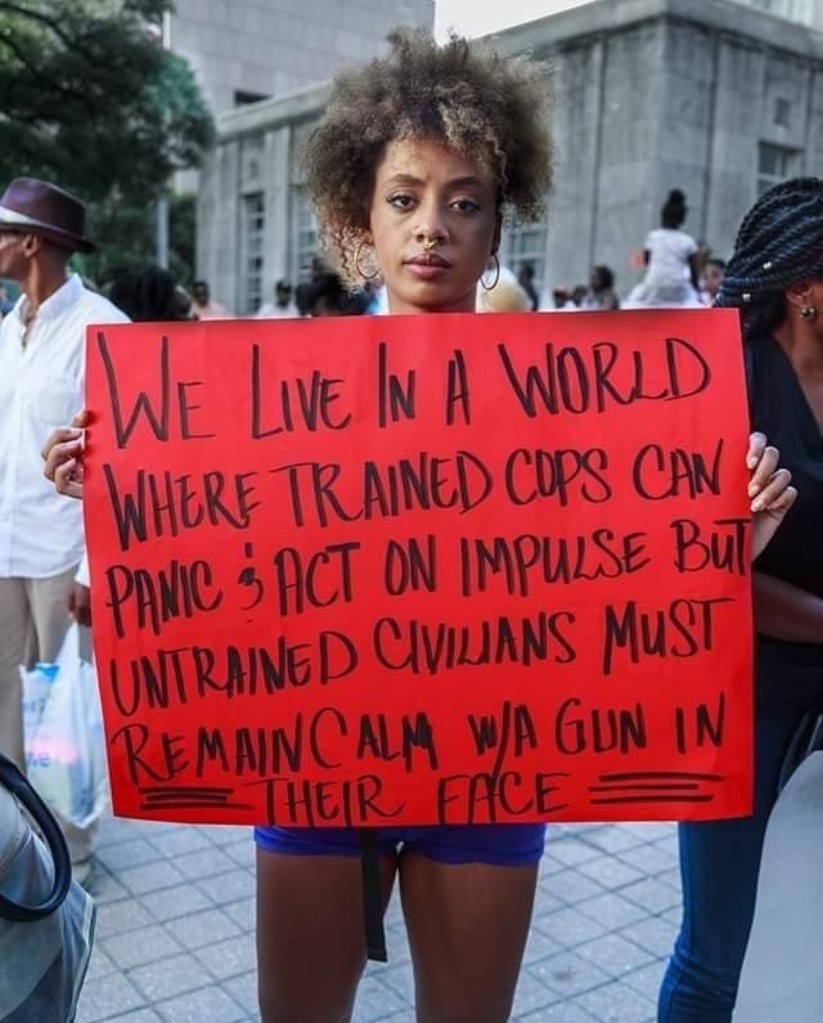
These are proposed Pennsylvania state government policies that I hope local people consider supporting. It’s not very exciting, but one of the best ways you can do this is to tell your local legislators they are important to you, and ask them to vote in the bills’ favor. I think these proposals are weak — mostly reinforcing existing policies — but they’re what we’ve got right now.
House Bill 1841: Would require employers to disclose information on applicants to law enforcement agencies as part of the hiring process; and create a database (accessible only by law enforcement agencies) containing police officers’ separation records, which include charges, complaints, and disciplinary actions against the officer.
House Bill 1910: Would require police officers to undergo more training on the use of deadly force, de-escalation tactics, and implicit bias; and to undergo PTSD screening after using lethal force.
House Bill 1664: Would stipulate that police may use deadly force only when an officer needs to “protect himself or another from imminent death, serious bodily injury, kidnapping or sexual intercourse compelled by force or threat.”
Senate Bill 459: Would require municipal police departments to adopt a use of force policy and to train officers on it, and to report use of force events to the state police.
Senate Bill 1205: Would stipulate that police officers may use chokeholds only in situations when the use of deadly force is permitted.
Thing to look at
These photos were taken this weekend at Lancaster Central Market, a thriving farmer’s market that’s important and dear to this city:
I think the photos (the clown face edit is mine, hehe) can speak for themselves. It’s a pathetic and sad sight to see, but most of all, it’s dangerous. I’ve seen several people describe how the man is wearing this semi-automatic weapon in a way that would make it relatively easy for his gun’s “safety” measures to be disengaged, and cause him to shoot a child at his waist height.
UPDATE (08/06/20): The man above, Andrew Josiah Goslin, was arrested on a number of charges stemming from an incident yesterday. He tried to use the gun pictured above to murder police officers.
Thing to read
Well, it’s not a thing. It’s one of the most heart-rending and important op-eds that have been published in a newspaper, IMHO. (I’ve lost faith in the NYT’s editorial section, but good on them for publishing this.)
I am a black, Southern woman, and of my immediate white male ancestors, all of them were rapists. My very existence is a relic of slavery and Jim Crow.
…
I am proof that whatever else the South might have been, or might believe itself to be, it was and is a space whose prosperity and sense of romance and nostalgia were built upon the grievous exploitation of black life.
The dream version of the Old South never existed. Any manufactured monument to that time in that place tells half a truth at best. The ideas and ideals it purports to honor are not real. To those who have embraced these delusions: Now is the time to re-examine your position.
Like most of us, I’m moved by the murder of George Floyd by four police officers. I believe Black people when they talk about the continued injustices and oppression they face, and I believe my role in this is to listen, but more importantly, use the skills I have to help dismantle the systems that keep this going.
On this post I’ll keep a running list of what I’m reading and listening to in that regard.
(I’ll talk about the action I’m taking separately, because as one of the first articles notes, enough sitting around talking about injustice — it’s each of our duty to act to dismantle it.)
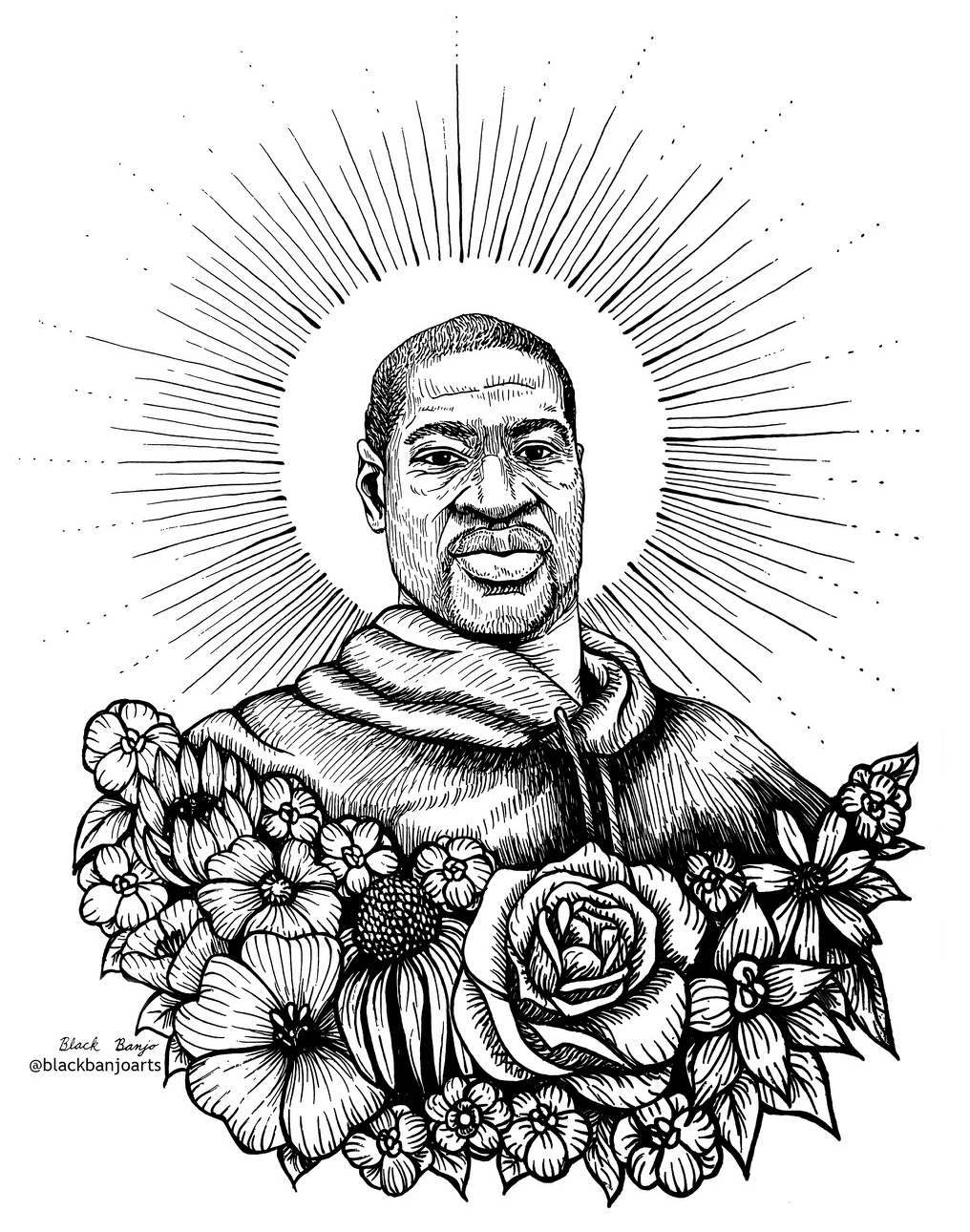
The above drawing is by Minneapolis artist Ellie Bryan. She originally shared it via her Instagram account, writing:
I don’t know what else I can do, so I’m drawing. George Floyd was murdered by the police in broad daylight less than 100 yards from the house that I grew up in and where my parents lived for 30 years. This man did not deserve this. He was crying for help. This could’ve been my dad, who is also a tall and imposing black man, but like George Floyd, a gentle giant. Stop killing us.
Because I’ve been here before, I know what happens next. In a handful of Sundays, my social media feeds will no longer have my white allies “This”-ing, or unpacking their whiteness or privilege, or nudging their kids to put down their tablets and march. Their book clubs will do what all book clubs do: devolve into routine reschedulings and cancellations; turn into collective apologies for not doing the reading or meta-conversations about what everyone should pretend to read next; finally become occasional opportunities to catch up over wine. It is hard and harmful to know that all of this keeps them in a comfortable place, even if doing just a little feels like a reach when the Race Alarms are sounded.
…
The right acknowledgment of black justice, humanity, freedom and happiness won’t be found in your book clubs, protest signs, chalk talks or organizational statements. It will be found in your earnest willingness to dismantle systems that stand in our way — be they at your job, in your social network, your neighborhood associations, your family or your home. It’s not just about amplifying our voices, it’s about investing in them and in our businesses, education, political representation, power, housing and art.
– Tre Johnson
I met Gabby Richards, communications director for Congresswoman Mary Gay Scanlon, while covering an event in Philadelphia. She tweeted her story about having The Conversation with her parents as a black child:
Read the thread easily here if you don’t have Twitter.
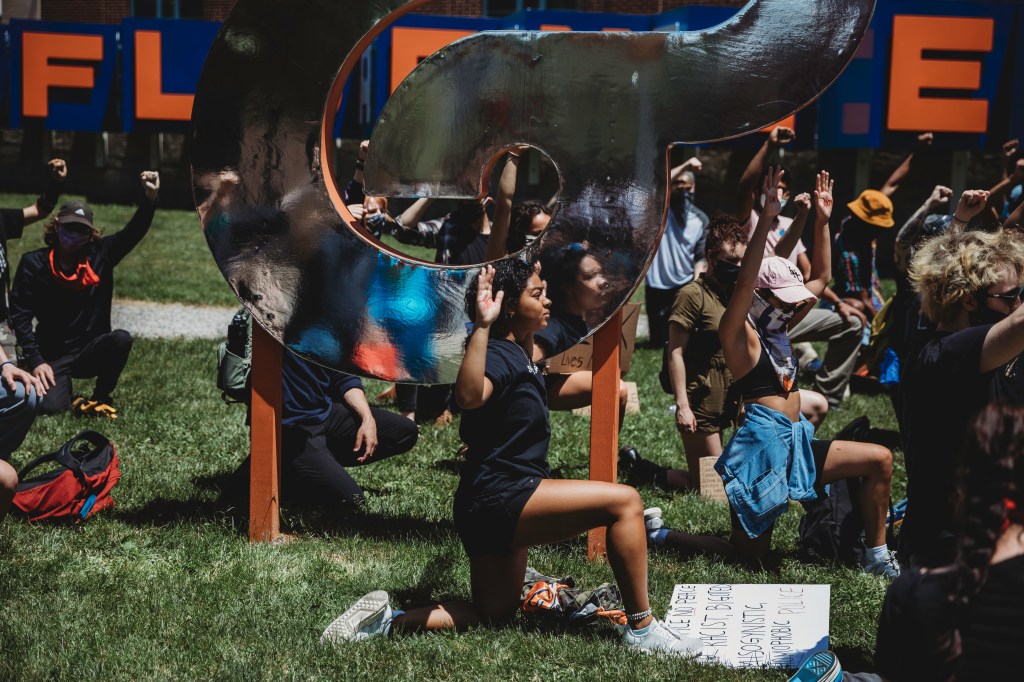
People in my town of Lancaster, PA marching in honor of George Floyd and against police brutality. Photo by Michelle Johnsen, who is chronicling the continuing protests here. Please email her for permission to use any of her photos, and for the guidelines.
“Kids Don’t Start Racist” – essay by John Powell, teacher and Mennonite pastor (who once left the Mennonite church because of the racism he experienced within, but was drawn back in — that story is another fascinating read)
While shopping last year, a white child about 4 years old pointed at me and asked his mother, “Is that a n—er?” The mother took the child’s hand, looked at me and quickly disappeared. I wasn’t expecting that question. I thought every child had seen a black person. Why use the “N” word? It was obvious the child had heard someone using it. Was hatred being instilled in this child so young?
Hey, white friends: Remember when you imagined who you’d be in Nazi Germany or during Civil Rights? How you never envisioned yourself as frightened, complicit, allowing power to harm people trying to be free? Guess what. Who you are now is your role in history. Show up.
The image links to ProPublica’s guide to collecting publicly available information about your local police department. ProPublica is a non-profit investigative journalism publication. Many of its reports have led to arrests, law changes, and policy changes. I subscribe to their daily & weekly news digests.
“There’s One Big Reason Why Police Brutality Is So Common In The US. And That’s The Police Unions” – article by reporter Melissa Segura. She writes that, “police observers, scholars, and civil rights lawyers and activists say that the strength of these unions and the deals they strike with local governments for rigorous job protections have helped create cultures in which the officers are left unaccountable, and black and brown people are left dead.”
“On the Minds of Black Lives Matter Protestors: A Racist Health System” – article by journalist Akilah Johnson. Says the teaser: “Black lives are being lost to COVID-19 at twice the rate of others. For protesters we talked to, that’s one more reason to be on the street. ‘If it’s not police beating us up, it’s us dying in a hospital from the pandemic.'”
Photo from a protest here in Lancaster by Jennifer Foster, a local photojournalist and friend. Jenny has been profiling the local police force for months, and her views on police reform are very different from mine. We’re having lots of discussions, and we apologize to each other after raising our voices 😉 What else can you do?
This photo of Bevin Biggers protesting police brutality first went viral five years ago. In a June 5th interview she explains: “It’s a photo from a protest that goes viral every time someone gets killed by a cop. When I know that I’m going viral, I know what it’s for: Somebody got killed.”
On June 2nd, Bevin rented a U-Haul truck and followed the protest route in Houston to hand out more than 10,000 bottles of water, several hundred snack packs, and first aid kits to people marching with George Floyd’s family.
“The Story Has Gotten Away From Us” – essay by Betsy Morais and Alexandria Neason, who work at Columbia Journalism Review. The piece breaks down the past six months of events in America, and how they’re all connected, and all fueled (at least in part) by America’s institutional racism: “For the most part, journalism has decided that the coronavirus and the killing of George Floyd, a forty-six-year-old Black man, in Minneapolis, are two distinct stories. That’s fiction. Floyd’s murder, under the knees of a white police officer—and the demonstrations in response—occurred as part of a cascade of events.”
The article profiles Darnell Hill, a pastor and a mental health caseworker who teaches Black teenagers the emotional and physical coping strategies of living under systemic racism in America. “Part of Hill’s work is teaching the mechanics of navigating everyday encounters—from walking in a public space like a park to being stopped by the police or entering a business,” writes Anthony.